



In food processing, accurate ingredient dosing (flavours, bacterial cultures, additives, sauces, creams) is a critical operation. Any flow rate drift affects finished product quality, yields, and regulatory compliance.
The challenge of hygienic dosing
For decades, the progressive cavity pump (PCP) has been the default solution for these low-flow applications. Robust and capable of handling viscous or particulate-laden products, it nonetheless presents significant drawbacks that the process engineer cannot ignore.
The limitations of the progressive cavity pump
Progressive cavity technology relies on permanent contact between a metallic helical rotor and an elastomeric stator. This contact is, by nature, a source of wear and risk:
- Elastomeric stator: a consumable in the product zone, with a contamination risk from rubber fragments.
- Rotor-stator contact: generates shear, potentially degrading sensitive products (live cultures, emulsions, gels).
- Complex cleaning: the long helical geometry complicates CIP and increases downtime.
- Large footprint: most PCPs are bulky, complicating integration into compact skids.
- Dry-run sensitivity: forgetting to prime can destroy the stator in seconds.
- Limited direct servomotor coupling: most PCPs require an intermediate gearbox.
The Ampco ZP4: a fundamentally different approach
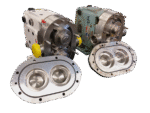
The Ampco ZP4 circumferential piston pump (CPP) is designed from the ground up for sanitary dosing and low-flow applications. Its operating principle eliminates the root causes of progressive cavity pump problems.
In a CPP, two rotors turn in opposite directions without ever contacting each other or the pump body. The rotation geometry itself creates the suction vacuum and displaces the fluid, without friction, without wear, without contamination.
Key advantages of the ZP4
- Zero rotor-to-rotor contact: no wear parts in the product zone.
- Ultra-compact format (200 × 89 × 127 mm): direct integration into existing skids.
- Direct servomotor coupling: precise flow control without an intermediate gearbox.
- Self-priming: reliable at start-up and during process variations.
- 5 seal configurations: adapts to the strictest sanitary requirements.
- 316L stainless steel body and Alloy 88 non-galling rotors: durability without contamination risk.
- Front-loading seal: simplified maintenance and cleaning.
- Viscosity up to 200,000 mPas: suited for thick products.
Ampco ZP4 technical specifications
| Max. pressure | 290 PSI / 20 BAR |
| Max. viscosity | 200,000 mPas |
| Displacement | 0.0051 L/rev |
| Dimensions (L × W × H) | 200 mm × 89 mm × 127 mm |
| Body | 316L stainless steel |
| Rotors | Alloy 88 non-galling |
| Gearbox | 304 stainless steel |
| Seal options | 5 configurations available |
| Motor coupling | Direct servomotor |
ZP4 vs. progressive cavity pump
| Criterion | Sanitary progressive cavity pump | Ampco ZP4 |
| Wear parts in product zone | Yes (elastomeric stator) | No |
| Rotor-to-stator contact | Yes | Zero |
| Footprint | Large | Very compact |
| Servomotor compatible | Not directly | Yes, direct |
| Cleaning / CIP | Complex | Simple |
| Handles particulates | Yes | Yes |
| Dry run tolerance | Poor | Better |
| Product shear | Moderate to high | Low |
| Max. pressure | Variable | 290 PSI / 20 BAR |
| Max. viscosity | High | 200,000 mPas |
Typical applications
The ZP4 is particularly well-suited for the following uses in food and dairy industries:
- Flavour, colorant and additive dosing in small quantities.
- Bacterial culture and starter injection (dairy inoculation).
- Pumping high-viscosity creams, sauces and coulis.
- Syrup, juice concentrate or beverage base dosing.
- Precise transfer of products with delicate particulates (fresh cheeses, fruit pieces).
Conclusion
The progressive cavity pump has served well for decades. For dosing in sanitary food or dairy environments, the ZP4’s circumferential piston technology now represents a more reliable, easier-to-maintain, and easier-to-integrate alternative.
Zero wear parts in the product zone, compact format, direct servomotor coupling: the ZP4 meets today’s requirements for precision, cleanliness, and integration flexibility.
Have a sanitary dosing application?
Our engineering team will evaluate your application and recommend the right ZP4 configuration for your needs.
info@nxtprocess.com · (514) 613-6535